Humanoid Robots
From science fiction to the factory floor — why 2026 is the year humanoid robots become market-ready.
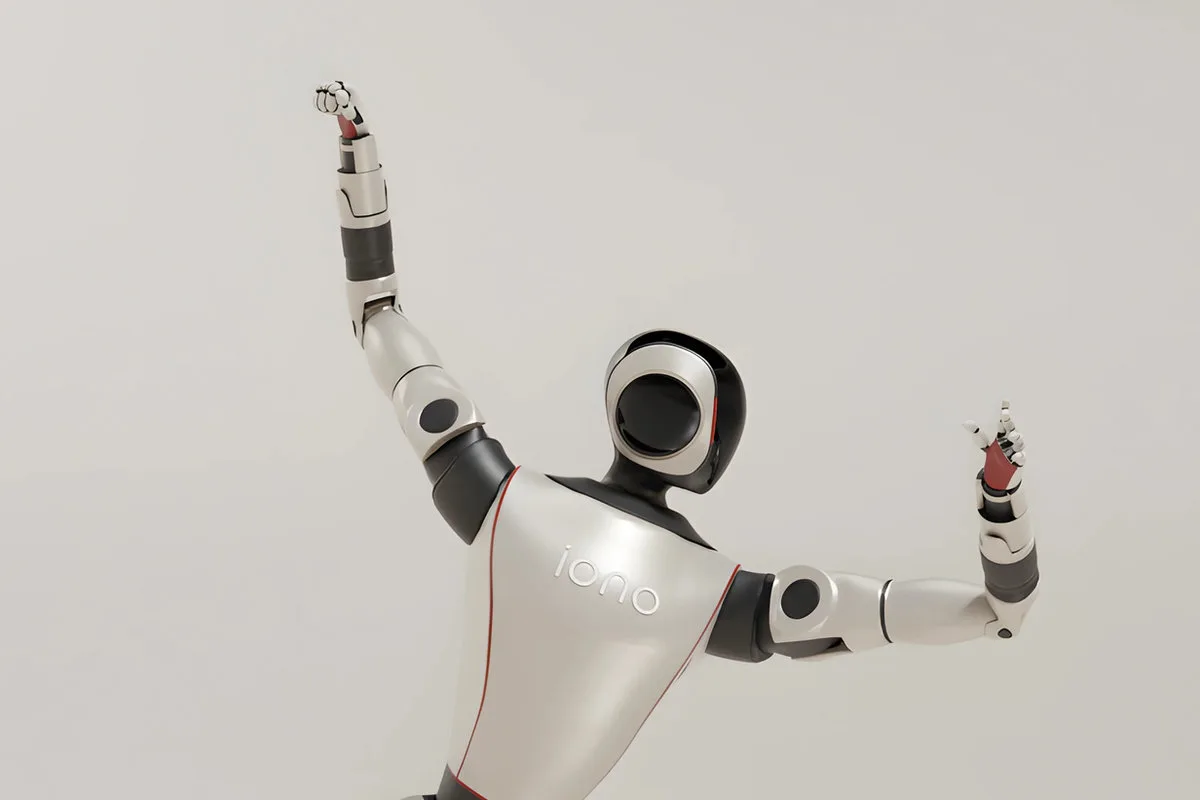
Humanoid robots reach an inflection point in 2026: Goldman Sachs sees $38B TAM by 2035, Figure AI is valued at $39B, Tesla plans mass production of Optimus, and Unitree has already shipped 5,500+ units. Europe holds just 6% of deployments — but Neura Robotics (EUR 120M+ funding) and Austria's Iono Robotics are working to change that. The key: AI-driven autonomy makes robots flexible enough for real work environments for the first time.
The robots are coming — for real this time
Humanoid robots have been a promise for decades. Honda unveiled ASIMO back in 2000. Boston Dynamics showed spectacular parkour videos with Atlas. But none of these systems ever made it into productive use. 2026 changes that. The difference from previous generations: modern foundation models give robots the ability to understand unstructured environments and react flexibly to new situations for the first time — without being manually programmed for every task.
The result: a wave of investment that dwarfs everything before it. Figure AI is valued at $39B. Tesla plans mass production of Optimus starting in 2026. Unitree has already shipped over 5,500 units of its G1 — at an entry price of $13,500. And in Austria, Iono Robotics is building the country's first domestic humanoid robot.
What research shows
projected market volume for humanoid robots by 2035. Goldman Sachs sees the market growing from under $10B to $38B — driven by advances in AI, sensor technology, and actuation. In the optimistic scenario, even $150B. Bank of America projects up to 3 billion robots by 2060.
We don't want to build dancing robots that entertain but create no value. We build robots that work.
— Ümit Bas, Founder & CEO Iono Robotics
Who is building the robots of the future?
The humanoid robot market is as dynamic as any technology field. Players range from tech giants to VC-funded startups to European specialists. An overview of the most important actors.
Global players
Tesla Optimus (Gen 3)
Tesla's humanoid robot, in test deployment in its own factories since 2024. Gen 3 (2026) with 22 degrees of freedom in the hands. Target: mass production and sales from 2026, target price $20,000–30,000. Elon Musk predicts Optimus could become Tesla's most valuable product.
Figure AI (Figure 02)
The highest-valued robotics startup: $39B valuation after the latest funding round ($2.6B). Deployed at BMW in Spartanburg. Cooperation with OpenAI for natural language control. Approximately 1,000 employees.
Unitree G1 / H1
Chinese manufacturer disrupting the market with aggressive pricing. G1: entry price $13,500, over 5,500 units shipped. H1: industrial model. Demonstrates impressive mobility (backflips, stairs). Focus on educational institutions and research.
Boston Dynamics Atlas (Electric)
The pioneer. Hydraulic Atlas was retired in 2024, electric Atlas (April 2024) targets commercial viability. Partnerships with Hyundai and Toyota Research Institute. Focus: automotive and logistics.
Europe and the DACH region
Europe currently holds just 6% of global robotics deployments. But two companies are working to change that — demonstrating that innovation doesn't only happen in California and Shenzhen.
Neura Robotics (DE)
Europe's best-funded humanoid robotics startup: EUR 120M+ funding, $1B+ valuation, over 400 employees in Metzingen, Germany. 4S (planned for 2025/26): 170 cm, 75 kg, 20 kg payload, up to 18h runtime. Cognitive capabilities through proprietary AI. Partnerships with Mercedes-Benz and Siemens.
Iono Robotics (AT)
Austria's first humanoid robot manufacturer. Founded April 2025 by Ümit Bas in Linz. IONO V1: 177 cm, 70 kg, 30 kg payload, 6 mobility variants. IonoSphere software platform for fleet management and AI control. Market launch 2026. Focus on industrial applications with practical design.
What research shows
of global robotics deployments are in Europe — compared to 52% in China and 31% in North America. Gartner predicts fewer than 20 companies worldwide will achieve series production of humanoid robots by 2028. European industry is investing more: the EU Robotics Fund has committed EUR 250M for European robotics startups.
Why now? The three breakthroughs
Three technological breakthroughs make 2026 the inflection point for humanoid robots: foundation models for robotics, hardware cost reduction, and the convergence of AI and sensor technology.
1. Foundation models for robotics
What GPT was for language, foundation models will be for robotics. Google DeepMind showed with RT-2 that vision-language models can control robots without being trained for every task. NVIDIA released GR00T N1, an open-source foundation model running on the Jetson Thor platform. And Physical Intelligence demonstrated with Pi-0 that a single model can control different robot platforms.
2. Hardware becomes affordable
The Unitree G1 costs $13,500 — less than a mid-range car. Tesla plans Optimus at $20,000–30,000. Five years ago, the cost for a humanoid robot was several hundred thousand dollars. The combination of better actuators, cheaper sensors, and standardized components is driving production costs down rapidly.
3. AI + sensors = autonomy
Cameras, LiDAR, force-torque sensors, and tactile sensors are getting smaller, cheaper, and more precise. Combined with AI models that process multimodal sensor data in real time, robots emerge that can understand their environment and act adaptively — not just execute pre-programmed movements.
The hardware is solved. The differentiator is now software — the ability to teach a robot to work autonomously in an unstructured environment. That's exactly what we built IonoSphere for.
— Ümit Bas, Founder & CEO Iono Robotics
Use cases: Where humanoid robots create value
The first commercial deployments focus on areas where three factors converge: high labor costs, dangerous or ergonomically straining tasks, and repetitive work in semi-structured environments.
Logistics & Warehousing: Amazon deploys over 750,000 robots and is testing humanoid systems from Agility (Digit) and Figure AI. Agility has announced 3,000+ units. Automotive: BMW deploys Figure 02 in Spartanburg. Mercedes-Benz tests Neura Robotics and Apptronik Apollo. Healthcare: 77% of Germans support robots in the workplace. Care robotics and lab automation are the first scalable applications. Hospitality: South Korea already has over 40,000 service robots deployed. The DACH hospitality industry shows strong interest in concierge and logistics robots.
What research shows
of Germans support the use of robots in the workplace — a significantly higher acceptance than just a few years ago. The survey shows: fear of job loss is giving way to the realization that robots primarily take over tasks that humans don't want to or can't do. Acceptance is particularly high in care (82%) and industrial manufacturing (79%).
Iono Robotics: Humanoid robots from Austria
While most European countries are still discussing robotics strategies, Ümit Bas is building facts in Linz, Austria. Iono Robotics — founded in April 2025 — is Austria's first humanoid robot manufacturer. The IONO V1 isn't a research platform; it's designed for industrial use: 177 cm, 70 kg, 30 kg payload, six different mobility variants depending on the deployment scenario.
What sets Iono apart from many competitors: the software-first approach. The IonoSphere platform enables fleet management, AI-driven task planning, and over-the-air updates — comparable to what Tesla established for electric vehicles. The robot isn't programmed once and then forgotten; it continuously learns and can be centrally controlled.
Bas brings over 20 years of software development experience — including from the automotive industry. He studied Software Engineering at FH Hagenberg and understands both the technical and practical requirements of industrial environments. As part of the Radical Innovators network, he is the specialist for IoT, AR, and robotics.
Austria has a strong industrial tradition and excellent engineers. There is no reason why humanoid robots shouldn't also be built here. With Iono, we want to show that Europe doesn't have to be just a spectator in this key technology.
— Ümit Bas, Founder & CEO Iono Robotics
Prices, timelines, and reality check
The price range for humanoid robots currently spans from $13,500 (Unitree G1, base model for research) to over $250,000 (Agility Digit, industrial model). Most manufacturers communicate target prices between $20,000 and $50,000 for mass production — but these numbers should be taken with caution.
Reality check: Gartner predicts fewer than 20 companies will achieve series production by 2028. The gap between demo and deployment remains large. Battery life is an unsolved problem — most systems last 2–4 hours under load. Regulation (EU Machinery Regulation, AI Act) is not yet designed for humanoid robots. And the question of who is liable when a 70 kg robot makes a mistake has not been conclusively answered in any jurisdiction.
What research shows
companies worldwide will achieve series production of humanoid robots by 2028 — despite over 100 startups in the market. The biggest hurdle isn't technology but scaling: producing precision components (actuators, sensors, joints) in sufficient quality and quantity requires massive capital investment and years of manufacturing expertise.
Our approach at Radical Innovators
Humanoid robots are not an isolated technology — they are the convergence of AI, IoT, computer vision, and industrial automation. These exact intersections are our terrain. With Ümit Bas and the Iono Robotics team, we have one of the leading experts in humanoid robotics directly in our network.
For companies that want to engage with this topic, we offer three entry points: a strategic feasibility analysis that clarifies whether and where humanoid robots can create value in your processes. Pilot projects with robotics platforms that deliver the proof of concept. And the development of software interfaces that integrate robots into existing IT infrastructure — from ERP connectivity to IoT sensor systems.
Companies that start understanding and testing humanoid robotics now will have a massive advantage in three years. Not because the technology is perfect — but because the learning curve is steep and integrating into existing processes takes time.
— Ümit Bas, IoT & Robotics Expert at Radical Innovators