Industry 5.0
Human-centric, sustainable, resilient: Why the next industrial revolution isn't pitting machines against people — but uniting both. With digital twins, predictive maintenance, and smart factories.
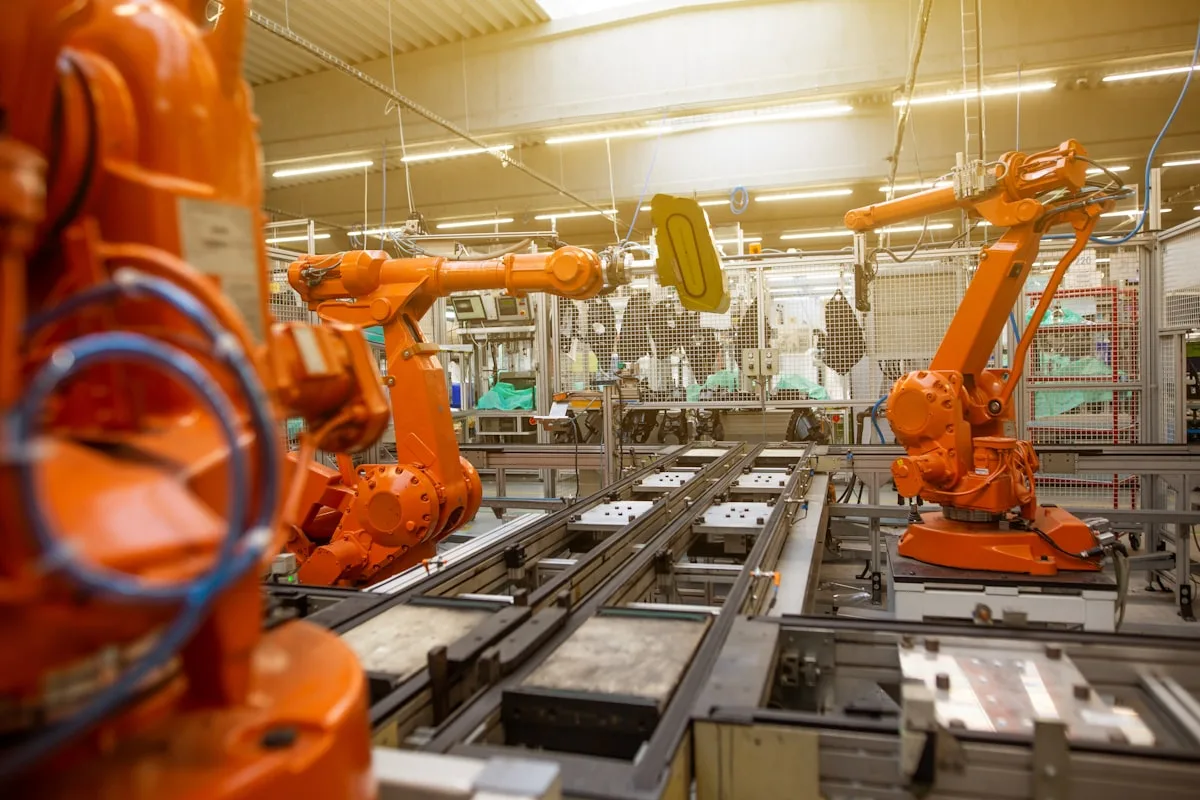
Industry 5.0 goes beyond pure automation: the EU defines it as human-centric, sustainable, and resilient. The AI-in-manufacturing market grows from $34.18B (2025) to $155B by 2030. Digital twins ($24–36B → $328–385B by 2033/34), predictive maintenance ($14.29B → $91B by 2033), and computer vision (95–99%+ detection accuracy) deliver measurable ROI within 6–12 months. DACH hidden champions like Siemens, Festo, TRUMPF, and Schaeffler show how it's done — but 76.4% of all manufacturing AI projects fail, 95% of operational data goes unused, and the talent shortage (1.6M open positions) slows scaling.
Siemens Amberg: 99.9% quality — and why that's just the beginning
At the Siemens plant in Amberg, 17 million components pass through production every day. The defect rate: 0.1%. That means 99.9% quality — with annual savings exceeding $35 million — with an overall ROI of 360% and cumulative savings exceeding EUR 500M since full digitalization. No science fiction, no PowerPoint vision. Reality, today. Amberg is the reference factory for what the European Commission calls “Industry 5.0”: manufacturing that isn't just intelligent and connected, but human-centric, sustainable, and resilient.
A few kilometers south, at BMW's Regensburg plant, the iFACTORY system plans new production lines in 3 days instead of 4 weeks — at 30% lower planning costs. Across the group, BMW achieves 42% efficiency gains through Digital Twins. In Nanjing, Siemens increased productivity by 20% with its digital twin factory. And at Bosch, over $2.7 billion flows into AI investments that cut electricity consumption by 18%. This isn't a future vision. It's the status quo of German manufacturing — at least among the leaders.
But the broader reality looks different: 77% of manufacturing companies worldwide have launched AI initiatives, yet only 10% are at full scale. In the DACH region: 56% partial adoption, 10% full integration. The gap between lighthouse projects and broad rollout is the central challenge — and simultaneously the biggest opportunity for companies that act now.
From Industry 4.0 to 5.0: More than just technology
Industry 4.0 was about connecting machines. Industry 5.0 is about connecting machines with people — and with clear purpose. The European Commission defines three pillars: Human-centric (cobots, augmented workers, ergonomic workplaces), Sustainable (energy efficiency, circular economy, CO₂ reduction), and Resilient (flexible supply chains, decentralized production, crisis resilience). This isn't academic theory. It's the regulatory framework shaping EU funding programs, standardization, and industrial policy. With EUR 14B for Horizon Europe 2026–2027 and the Clean Industrial Deal (EUR 100+B), the EU backs this vision with concrete investments.
The market is massive: Industry 4.0 is valued at $149–260 billion, with Germany's segment alone at $13.64 billion. AI in manufacturing grows from $34.18 billion (2025) to $155 billion by 2030 — a compound annual growth rate of 35.3%. The German AI market overall: over €9 billion (2025), projected to reach €37 billion by 2031. The cobot market alone grows from $2.95B (2025) to $17.2B by 2033 (CAGR 23.1%) — with NEURA Robotics from Metzingen as the European star with EUR 1B in orders booked.
What research shows
is the projected AI-in-manufacturing market by 2030 — up from $34.18B in 2025 (CAGR 35.3%). The broader Industry 4.0 market stands at $149–260B. Germany's segment: $13.64B. While 77% of manufacturers have launched AI initiatives, only 10% are at full scale. In the DACH region: 56% partial adoption, 10% full integration. Scaling — not starting — is the real challenge.
Digital twins: The virtual factory becomes reality
A digital twin is a high-precision virtual copy of a physical asset — a machine, a production line, an entire factory. It's fed real-time sensor data, simulates scenarios, and enables optimization before a single action is taken in the physical world. The market is growing explosively: from $24–36 billion (2025) to $328–385 billion by 2033/34.
The results aren't theoretical. Siemens Amberg achieves 99.9% quality and saves over $35 million annually through its fully digital-twinned manufacturing process. Siemens Nanjing boosted productivity by 20% with the same approach. PepsiCo increased throughput by 20% through digital twin simulation of its production lines. At Bayer, a 10-month optimization process was compressed to 2 minutes — through virtual simulation instead of physical trial-and-error. And GM reduced unplanned downtime by 25%.
What research shows
is the projected digital twin market by 2033/34 — up from $24–36B in 2025. The technology has exited the hype cycle and delivers measurable ROI: Siemens Amberg (99.9% quality, >$35M savings/year), Siemens Nanjing (+20% productivity), PepsiCo (+20% throughput), Bayer (10 months → 2 minutes), GM (−25% unplanned downtime). Digital twins are the key to Industry 5.0: they enable optimization without production interruption.
Predictive maintenance & computer vision: Hard ROI for manufacturing
Predictive maintenance is the business case that convinces boards. The market: $14.29 billion, growing to approximately $91 billion by 2033. Real-world numbers: Siemens cuts maintenance costs by 30% and downtime by 50%. ThyssenKrupp improves reliability by 50%. Festo AX saves $16,000 per machine — with ROI under one year. Schaeffler built a complete predictive maintenance ecosystem with OPTIME that's accessible even for mid-market manufacturers.
Computer vision for quality control delivers equally hard numbers: 95–99%+ detection accuracy, 30–40% defect reduction, ROI in 6–12 months. BMW deploys computer vision across all plants. Toyota reduced defects by 30%. Pegatron — one of the world's largest electronics manufacturers — achieved a 67% defect reduction. The technology is mature: Cognex systems process 1,200 parts per minute, Landing AI democratizes visual inspection for SMEs, and Instrumental connects defect detection with root-cause analysis.
What research shows
is the projected predictive maintenance market by 2033 — up from $14.29B today. ROI is proven across industries: Siemens (−30% costs, −50% downtime), ThyssenKrupp (+50% reliability), Festo AX ($16,000 savings/machine, <1 year ROI). Computer vision for quality control complements with 95–99%+ accuracy and 6–12 month payback. Investments range from $5,000 (simple chatbots) to $1M+ (complex vision/LLM systems). Average ROI: 3.5x (Microsoft study), top performers reach 8x.
DACH engineering meets AI: Hidden champions leading the way
The DACH region has a unique advantage: deep domain expertise in mechanical engineering, combined with a manufacturing culture that carries precision and quality in its DNA. That's exactly what makes AI projects here particularly effective — because the data comes from machines that already rank among the world's best.
The hidden champions show how it's done: TRUMPF invested $40 million in its smart factory and developed the AI Cutting Assistant, which evaluates laser cutting quality in real time. Festo deploys AX Industrial Intelligence — a platform that brings predictive maintenance and quality optimization directly into the production line. KUKA integrates AI into its robotics for adaptive assembly and collaborative processes. Schaeffler connects its entire drivetrain and bearing technology for predictive maintenance through OPTIME. SICK AG brings deep learning to industrial sensors. Weidmüller automates control cabinet manufacturing with AI. And EBM-Papst optimizes fans and drives through AI-powered simulation.
Bosch: Over $2.7B AI investment, −18% electricity consumption through AI optimization, agentic AI platform for autonomous manufacturing decisions. BMW iFACTORY: 3 days instead of 4 weeks planning time, −30% planning costs. TRUMPF: $40M smart factory, AI Cutting Assistant for real-time quality assessment. Festo AX: $16,000 savings per machine, ROI under 1 year. These companies prove: German engineering and AI aren't opposites — they amplify each other. Germany ranks #4 globally with 429 robots per 10,000 workers — behind South Korea, Singapore, and Japan. Siemens and NVIDIA are building an AI-driven factory in Erlangen starting 2026 — a lighthouse project for merging Digital Twins and generative AI.
Siemens Xcelerator
Siemens' open digital platform for industry and infrastructure. Xcelerator connects digital twins (Tecnomatix, Plant Simulation), IoT (MindSphere/Insights Hub), industrial AI, and low-code development. Reference: Amberg (99.9% quality), Nanjing (+20% productivity). Over 1 million users worldwide.
PTC ThingWorx
Industrial IoT platform for connected operations. ThingWorx connects machines, collects sensor data, and enables real-time dashboards, predictive analytics, and augmented-reality-assisted maintenance (via Vuforia). Strong in discrete manufacturing and mechanical engineering.
Cognex ViDi
Deep-learning-based industrial machine vision. ViDi requires minimal training images (often 20–50 good parts) for defect detection, classification, and OCR. 1,200 parts/minute throughput. Deployed at BMW, Toyota, and hundreds of manufacturing operations. Industrial-hardened hardware.
Festo AX (Industrial Intelligence)
Festo's AI platform for predictive maintenance and quality optimization directly in the production line. AX analyzes sensor data from pneumatic and electric drives, detects anomalies, and predicts failures. $16,000 savings per machine, ROI under 1 year. Specifically designed for mid-market manufacturers.
The 76% hurdle: Why manufacturing AI fails
76.4% of all AI projects in manufacturing fail. That number isn't pessimism — it's a wake-up call. The causes are systemic, not technical: 95% of operational data in factories goes unused. Not because the data doesn't exist, but because it's trapped in silos — in PLC controllers, SCADA systems, MES databases, and spreadsheets that were never designed for AI analytics.
Three additional hurdles compound the problem: First, the talent shortage — 40% of German companies can't find AI talent, 1.6 million positions remain unfilled. The Mittelstand invests only 0.35% of revenue in AI — 30% below market average. Second, scaling: pilots work, but the leap from one machine to an entire production line requires data architecture, change management, and OT/IT convergence. Third, the AI supply chain gap: AI in demand forecasting achieves 8–15% MAPE versus 35–45% with traditional methods and enables 18–28% inventory reduction — but 75%+ of companies won't deploy supply chain AI until 2026. The early-mover advantage is real.
Connectivity advances: Germany leads Europe with 49 private 5G deployments (Mercedes Factory 56, BMW Leipzig, Bosch Stuttgart). Edge AI achieves 99.97% accuracy in defect detection. And then there's cybersecurity: manufacturing is the #1 target for ransomware attacks — up 61% in 2025. Only 14% of manufacturers feel fully prepared for OT threats. Connected factories exponentially expand the attack surface. Anyone building a smart factory without considering OT security is building on sand.
What research shows
of all AI projects in manufacturing fail. Root causes: 95% of operational data goes unused (data silos, missing architecture). 40% of companies can't find AI talent with 1.6M open positions. The Mittelstand invests only 0.35% of revenue in AI. Meanwhile, manufacturing is the #1 ransomware target (+61% in 2025), only 14% feel prepared for OT threats. Investment range: $5,000 (chatbots) to $1M+ (computer vision/LLM). Payback: 6–12 months (PdM/vision), 18–24 months (GenAI). Average ROI: 3.5x, top performers 8x.
Our approach at Radical Innovators
Industry 5.0 isn't a technology project — it's a transformation project. And that's precisely where our strength lies: we combine deep technical understanding of digital twins, predictive maintenance, and computer vision with the strategic experience to make these technologies fly in the Mittelstand. No agency overhead, no slide-shuffling. Instead, a single point of contact who assembles the best specialists for every project — from sensor experts to OT security architects.
We start with a readiness analysis: where do your data, infrastructure, and organization stand? Then we identify the use case with the highest impact-to-effort ratio — typically predictive maintenance or quality control. Pilot in 8 weeks, measurable ROI in 6 months. And then we scale — not launching the next pilot, but rolling out the success model across the operation. We've guided manufacturing projects across six continents, but our heart beats for DACH mechanical engineering.
German engineering and artificial intelligence aren't opposites — they're the most powerful combination global manufacturing has ever seen. The question isn't whether your factory will become intelligent, but whether you'll shape it yourself or get overtaken by the competition. A 76% failure rate doesn't mean AI doesn't work — it means execution makes the difference. That's exactly what we're here for.
— Martin Kocijaz, CEO Radical Innovators